Sunday, May 15, 2011

More DNA knitting

I few weeks ago, I posted about a DNA-themed scarf I'd knitted for a friend of mine. As it was the seventh time I'd knitted that scarf, I took the opportunity to think less about the yarn and needles, but the social relationships the making and sharing the scarves and the pattern reflected. Here's another, different, DNA-themed piece. Again, I want to reflect on the social connections this pattern reflects, because I think it's important.

DNA baby sweater


It’s a cardigan for a baby. The baby’s father is a science writer (another one) who is especially interested in genetics, so I used the cable pattern from June Oshiro's famous DNA scarf. It's a lovely pattern, with a lovely story behind it. In many ways, it inspired both my DNA illusion pattern (googledoc link) and the cosmic radiation scarf I made for my PhD supervisor. I've thought about knitting Oshiro's pattern many times, but just never got around to it.

The crafting of this cardigan reflects my friendship with the new baby’s parents, but it also reflects a sort of parasocial relationship with Oshiro (as in, I’ve never met her and doubt she knows who I am, but I feel as if I know her, as I know odd bits about her life through her blog). Beyond that, it reflects the relationship Oshiro had with a colleague who challenged her to design that scarf, over a decade ago now. Indeed, it reflects decades and decades of scientists connections with each other and broader popular culture. In many ways, the image of the double helix has become part of popular culture, or at least parts of public culture. That's one of the reasons so many people knit it. The book behind the cardigan in the photo is about this issue, and I guess my desire to knit the image reflects the fact I've studied this as a sociology undergraduate.

I used to work in the Science Museum, and would walk past the 1953 Watson and Crick model they have on display there a couple of time a day. So I have an odd set of personal and professional relationships with it too - ones that are different from the relationship a geneticist would have - and have seen people from all over the world stop and think through their relationships with the icon of the double helix as they stop by the exhibit too.

Back to that baby cardigan. It's actually a mash-up of two patterns, as I also used Elizabeth Zimmerman’s 'February baby cardigan' as the basic garment. Thus, it reflecting an older and broader set of connections to knitting communities, as well as, more personally, a connection to my friend Kirsty who gave me a book of Zimmerman patterns for my birthday a few years ago. In terms of my use of both patterns, crafting this piece also reflects various other social connections, of varying degrees of tangibility, throughout the online knitting community as I’ve tracked other uses of these two patterns.

Now I’m sharing it with you – and on ravelry – it reflects another set of connections, and opens itself to further possible ones too.

Monday, April 25, 2011

What am I knitting. Where am I knitting?

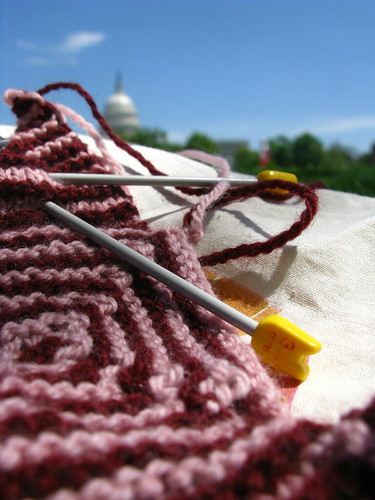
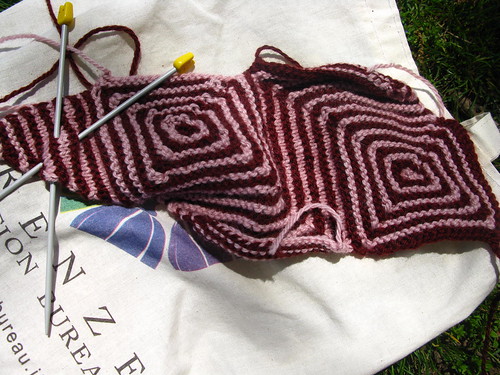
My latest work in progress, can you guess what it is yet?

knitting wip

It's going to be a scarf, based on the Step Up afghan from Woolly Thoughts. The pattern is the sort of super-logical and efficient-as-possible one I love. There's lots of picking up stitches, knitting one shape into another, and rules like all triangles are stocking stitch, or vertical parallelograms have garter stitch light-coloured stripes. I'm still getting to grips with these rules, but am getting there.

Rather than what am I knitting, a better question might be where am I knitting it? Ignore the old bag from a conference in Florence; that's a red herring.

knitting long

If you can't quite work out that white fuzzy dome in the background, here's a better shot, stepping out from the macro a bit:

knitting by capitol - portrait

I'm in DC for a couple of months, visiting faculty at American University, School of Communication. I'll also be spending a bit of time in New York, Philadelphia, Chicago, Toronto and Ottawa while I’m here. Any don't miss knitting things to do, people to see, yarn to squeeze? (don't think I can make Maryland Sheep and Wool).

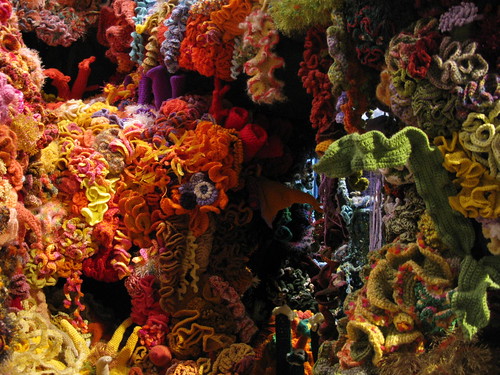
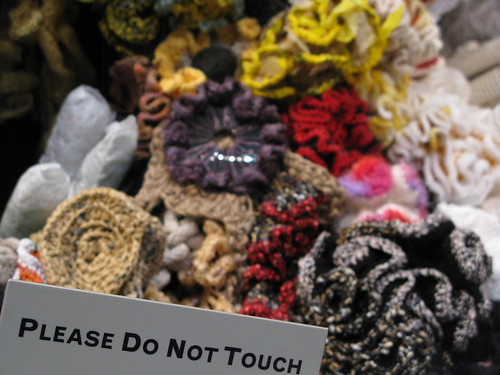
I just managed to catch the last day of the Crochet Reef display at the Smithsonian Museum of Natural History on it's last day. Best two overheards there: "it's not coral, it's made of sweater stuff" (but in a tone of "and OMG that is awesome") and "it wasn't just one person you know, it was loads of people, it's a community project" (again, clearly the speaker thought this was the best bit. I agree).

crochet reef - hanging

crochet reef


crochet reef - do not touch

Thursday, March 24, 2011

On the social nature of knitting

Here's a picture of my friend Ed wearing a DNA illusion scarf I've just knitted him. Ed's a prolific and highly respected science writer (he blogs at Not Exactly Rocket Science). He recently included me on a list of top science bloggers, and I joked that if he wanted me to knit him a scarf, he only need ask. I was serious too though. I appreciate the work Ed does, but I get to read it for free. Though he does get paid for much of his writing, he also puts a crazy amount of hours in. Knitting him a scarf was a way of saying thank you.

Ed in scarf

Illusion knitting is notoriously hard to photograph, so you might have to have a look at the video in this post to really get how the trick really works.  

As I've said before, DNA and illusion knitting seemed to be made for one another. The ladders of the striping pattern twist round those of the helix as purls and knit-stitches collect  to display a regular shape. I also like that you have know how to look at the scarf to really see the pattern. There's an "OH!" moment when you spot it. Symbolic of the science it reflects, the pattern isn't self-evident.

Presenting Ed with the scarf in the pub last night it was great watching other people respond to it too, and holding it up to the eyes to spot the illusion.

photographing Rosalind

I think this DNA illusion pattern is the knitting project I'm most proud of. It's not so much the product (though I do like the way it looks) or the process of knitting it (though I do enjoy illusion knitting). Rather, it's the social connections that making this scarf has either reflected or helped create.

I'm currently reading a new book about the social dimension of craft - Making is Connecting - so I guess this is on my mind at the moment.

The first one I made was for an ex-geneticist friend, as leaving present for work. I'd only recently learned to knit. Flatmate Kirsty had adapted the alien illusion scarf for her brother, with a picture of Che Guevara. I thought I'd try something similar, and that a design reflecting the iconic double helix would work really well with the illusion pattern.

Then I made another for a scientist/ knitter friend in New York, and wrote up the pattern to share. Then more started popping up. I've had emails from all over the world about the pattern. I've knitted the design into some socks for a science-teacher friend for his birthday, then as a baby blanket for a cousin, and then again as a scarf for a friend when she finished her PhD. I finally made one for myself too. A journalist from UK Wired emailed me and it ended up being mentioned there and it featured on this post on science-knitting. I swear I once spotted someone on the street wearing one (I was on the top deck of the bus at the time so couldn't run up to her and check).

The project is ravelled here if you want to see details of yarn, needles and mods. The pattern is available or through googledocs, or via ravelry.

money shot

Monday, January 24, 2011

A "strawman" scarf

strawman scarf 1

I don't know if you have ever heard the term "straw-man argument"? Loosely, it means arguments that are aimed at a problem that doesn't really exist. It's a classic debating technique. You make up an extreme version or caricature of your opponent's argument (the "straw-man") which is all the easier to knock apart.

So, the expression "but you're straw-manning me!" is a fair and useful term in some contexts (I have used it myself). It helps you point out and defend yourself against unfair criticism, and it helps you pass the rhetorical trick right back at your opponent as, by taking aim at the premise of their argument, it can be reasonably hard to think of a come back.

But the term can be overused. Sometimes what looks like a deliberately rhetorically constructed straw-man is simply a misunderstanding. It's accidental. In fact, it might even be the fault of the person claiming they've been straw-manned. If someone doesn't understand your position, maybe you didn't made yourself very clear in the first place?

Closing an argument with a call of "straw-man!" for a bit of oneupmanship in a debating chamber be all part of the fun, but if the aim is mutual understanding, I'm not convinced it's productive. I'd much prefer people took an interest in why they have been misunderstood/ are being misinterpreted. A lack of understanding can be a chance for everyone to learn: a chance to continue debate, not end it.

Having seen the term once too many one evening, I decided to exorcise my grumpiness the best way I know how: knitting.

strawman scarf 1

I thought about knitting a small straw-coloured toy, like the voodoo doll I made in a moment of whimsical annoyance at the structures academic admin a few years back.

But a doll's pretty useless - as much of my annoyance with the term phrase was that it's not productive, it seemed a bit silly. So, instead, I made a small straw-coloured scarf with a man symbol embroidered at one end. The stitch pattern is from My So Called Scarf, which I thought brought out a straw-y texture (see ravelry project page for full details about yarn, etc).

I've now posted it to a friend who was at the receiving end of some particularly unhelpful "you're just straw-manning me" bit of rhetoric last year. Because debate should be about sharing with others, not keeping the prizes for yourself.

strawman scarf 2

Sunday, January 09, 2011

Time catching up

2011 is the year I turn 30. This isn't something I'm especially worried about. You can't work in a university (as I do), surrounded by all the hope and energy of youth, and have a problem with feeling older. If anything, I quite like the idea of growing towards wise old biddie status.

Still, I admit that on opening a new calendar on the 1st of Janurary and realising this really was the year I'd leave my 20s, I painted my fingernails with purple glitter and dug out some very old CDs.

Luckily, I have a host of friends who have recently passed through the big 3-0 to guide me on my way. I've already blogged about flatmate-Kirsty turning 30. Here are two scarves I made over the Christmas break for other recently-turned-30 friends.

First up, a scarf for my old university friend, Uslan. You'll have to excuse the slightly dodgy iphone pics - I left my camera at home on the only afternoon I had the scarves before I wrapped them up to give them away.

me in Uslan's scarf

I've made a scarf for Uslan before (Exchequered, which is in Spring '06 Knitty) but that was about five years ago, so I offered a new one. We discussed size, shape and colour and after passing some example photos back and forth, this is the result: four skeins Colinette Point 5 knitted in brioche rib on giant 10mm needles (see ravelry project page). As Kirsty said about the yarn: it's as if Barbie was sick on a sheep.

The resulting scarf is also incredible long. A scarf to wrap yourself in and hide (or possibly just mask your wrinkles, not that Uslan has wrinkles, I'm sure).

buried in a Uslan's scarf

Secondly, a small shawlette for Anne-Marie, who I was at university with and worked at the Science Museum with too. Anne-Marie was also my old flatmate before I lived with Kirsty: we had a teeny-tiny little flat by Mornington Crescent (amazing views over Euston Station).

me in garter haruni

The pattern is Haruni by Emily Ross. This is meant to be entirely lace, but I subbed chart A for a bit of plain knitting, because that’s what the cool kids do. However, rather than the stocking stitch most people seem to opt for, I went for garter stitch. I'm on a bit of a garter stitch kick at the moment. I used felted tweed, which is supposed to be a DK weight, but is nearer 4ply so it's quite small, but a pretty little shawlette nonetheless (ravelry project page).