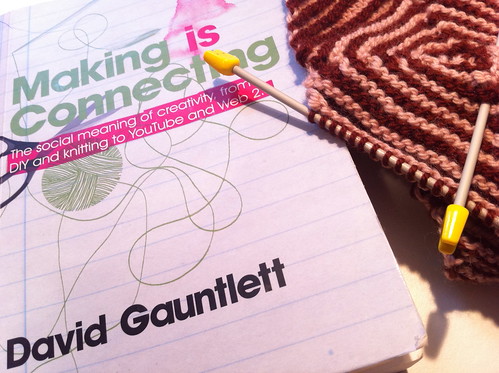
Again, this was first published on my work blog - sorry if you've already seen it. I'm posting it here too because I think knitters might be interested.
I've mentioned David Gauntlett's new book, Making is Connecting, a few times recently: on my work blog, my knitting one, and on the Guardian's Notes and Theories. It's an interesting book worth talking about. It's about the social meanings of creativity and 21st century maker cultures, be these makers of blogs, woolly cardigans, cupcakes, podcasts or physics-themed lolcats, and in particular the changing structures of making which surround what is sometimes called ‘social media’. As any seasoned media studies scholar will grump at you, all media is social, but with this thing we call web 2.0 the patterns of sociability are changing (Gauntlett has made a lovely vid on this) in ways which are wrapped up in the history of crafting.
It has, however, taken me a while to actually finish reading the book and post this review. This isn’t because it’s a hard read, or boring. Quite the opposite. For a piece of social sciences, it’s incredibly well written. Still, in a way, it is a book that inspires slow reading, because one of the many reasons why it took me so long to finish (why it takes me so long to finish most books, unless I make myself sit and read them in a go, or even watch a movie or er… finish this sentence) is that I get distracted. I stop consuming whatever other people have made – in this case Gauntlett’s book – and go and produce something for myself. I knitted, I cooked, I wrote, I gave lectures and organised events. Some of this I did myself, some of it collaboratively. Along the way, I also found stuff other people had made to consume and take part in too. And that’s why Making is Connecting might be ‘slow reading’. Because, this process of going off and doing something yourself is a lot of what the book is about.
One of the key frames of the book is a shift from the passivity of the ‘sit back’ model of what might come to be seen as the odd mid to late 20th century era of the television and towards a culture dominated by ideas of making and doing. People who watched British television at a certain point in the late 20th century may remember a show called Why Don't You Just Switch Off Your Television Set and Go Out and Do Something Less Boring Instead. So does Gauntlett.
I wondered at times whether this shift is over-stating in the book. Or at least that I we should be careful of putting them up against each other in terms of making. I love the passivity of some TV shows because they free me to knit in front of them (just knitting on its own doesn’t catch my attention enough). Or what about TV shows that draw on crafting cultures? (food TV, especially in the USA is fascinating here). Moreover, there are ways in which that big smooth professionally oiled machine of big media acts as a material for 21st century craft. One of the striking, not always appreciated, aspects of 21st century making is how much of it is re-making. Fan fiction is the classic case study of the complexity of such remaking culture. Take, for example, Constance Penley’s book NASA/Trek where she writes about people re-working the stories of Star Trek just as they also rework the various stories surrounding NASA.
A smaller topic, but equally interesting I thought, was that of mess. Gauntlett mentions this first when he is introducing web the notion of web2.0 and mentions a video from Chris Anderson, and then comes back to later when discussing the Jaron Lanier's book You Are Not a Gadget. It reminded me of my friend Felix’s great idea (a few years back now) of ‘messy Tuesdays’. Inspired by the ways in which some knitting and cooking bloggers seemed to be self-consciously styling their domestic lives to look like a glossy lifestyle magazine, Felix wrote up a manifesto (currently offline): ‘You are not your flawless surfaces. You are not your orderly laundry-pile. You are not the seamlessness of your Finished Objects. You are not your risen cakes. You are not your sewn-in ends’. As another blogger, Lara put it, ‘as someone who spent her teenager years wrapped in teenage angst about not being clever enough, pretty enough or thin enough, the idea that my home won't be beautiful enough, my craft not so well executed or my knitting up to speed has been at times quite tough’. They confidently posted about the less tidied-up bits of their lives, celebrating the beauty and reality of the mess that surrounds us all.
I sometimes think we should bring that back: #messytues has something on a twitter meme about it, no? I also think there’s potential for some research here. John Law is good on this topic, as a post on the ‘serendipity engine' reminded me recently. Although I’ve just quoted a couple of knit-bloggers, I think this idea of the reality, necessity and even beauty of mess has something to say about the way we tell science stories too (as the reference to Law may signal).
The point that most interested me about this book, however, was the way that Gauntlett, as a professor of media studies, is interested in people making media and mediating making. It’s all very popular culture orientated, with some nods to domestic life. The hand crafting of pharmaceuticals, for example, doesn’t get much of a look in. I wondered if this would have brought something else to the debate.
That’s one of the reasons why I referred to NASA/Trek. There are many other better works on fanfiction (e.g.) but I think Penley’s discussion of something as intrinsically ‘big science’ as the space race says something about the social arrangement of makers in late modern society. There is a danger that by focusing on the ways people make and remake some objects we further 'black-box' others. For example, I learnt how to knit from reading knit blogs. I can make a jumper. I can also blog about this on the super clever iphone I carry around with me. I don’t know how to make an iphone though, or even spin my own wool to make that jumper from. The latter is largely a matter of choice (I do at least know some blogs that’d teach me to spin and even what plants to grow to make my own dyes from, as well as a few people who have access to sheep for wool, or possibly even a llama). For the former though, I have no clue where to even start teaching myself, even if I did, the manufacture of an iphone is not exactly opensource. Most of the time, I’m ok with that cluelessness, it frees me up to be knowledgeable about other things, but it does also disempower me.
There are key ways in which most of us do not have the means to (media) production – from our inability to understand how to do anything but use (as in use as a consumer) the shiny computers so many of us carry around in our pockets, to more economic or legal issues like the one Martin Robbins recently flagged up on his post about web hosts as the Achilles heel of online journalism.
None of that is necessarily a criticism of the book. We all have to focus somewhere, and Gauntlett does touch on these issues a bit in his final chapter ‘Web 2.0 – not all rosy?’ Still, I was surprised not to see more on the sociologies of work, expertise and technology and finished the book wanting to hear more about anti-social aspects of DIY culture. I also suspect Gauntlett would get an intellectual kick out of the various aesthetics of steampunk maker culture (old post I wrote on an exhibition of such work).
To conclude, I do want to stress that Making is Connecting is a lovely book, not least because of Gauntlett realistically optimistic approach. Though he’ll happily call ‘rubbish!’ (his 10 things wrong with the media ‘effects’ model is justifiably a classic), he doesn’t wear an ability to be ‘critical’ like it's some sort of pin badge to show membership of the ‘very clever thinkers club’. Academics should be able to say they like things, and I like this book. I’ll end on a positive note, an honest one, and say if you are a maker of any sort, I can wholehearted recommend Making is Connecting. It’ll give you a chance to think about the history and philosophies of crafting cultures. It’ll lift you out of your own maker microculture to help you ponder your wider context. It inspired me to make this post, and others, and to think more about my making. So do read it, even if it does take you a few months to get around to finishing it because you keep putting it down to do something else instead.
Wednesday, May 18, 2011
Tuesday, May 17, 2011
Science and craft (post on the Guardian)
This is cross-posted from my work blog, apologies to the few weirdos who read both.
There seems to be more and more events happening which I can only describe as science-craft. I thought I'd write about it, and did a post for the Guardian Science blog.
There are overlaps here with sci-art projects, just as there are overlaps (sometimes problematic ones) between arts and crafts more generally. However, I think science craft events have the potential to involve new and different communities which sci-art doesn't necessary reach, and to be more participatory in their whole project set up too.
There is the question of what you participate for exactly: what are you making? At danger of repeating myself, science communication isn't all about baking a cake shaped like a neuron. In particular, I worry that the fluffier ends of sci-craft might act as a distraction from the production of more politically controversial outcomes.
Still, we shouldn't loose sight of the use of these more playful products too. Or rather, we shouldn't ignore the power of the social interactions which surround their production. My knitting friends often laugh at me for being a 'process knitter'. I'll happily take a piece apart and re-knit it, several times. Finishing is nice. But, for me, the fun's in the doing. Similarly, I suspect much of the worth of public engagement happens in the process rather than the outcome. The various collaborative processes often involved in crafting can provide a space for people to talk through and think through ideas together. As I end the piece for the Guardian:
Not all public engagement can or should have an obvious political or scientific outcome. Whether you want to open up the governance of science or increase the public understanding of science, you are unlikely to get anywhere without quite a bit of cultural change first. Playing with a bit of yarn might seem unambitious, but arguably the social interaction and reflection that comes with it can help us get there. Or this social interaction might lead us somewhere else entirely.
There seems to be more and more events happening which I can only describe as science-craft. I thought I'd write about it, and did a post for the Guardian Science blog.
There are overlaps here with sci-art projects, just as there are overlaps (sometimes problematic ones) between arts and crafts more generally. However, I think science craft events have the potential to involve new and different communities which sci-art doesn't necessary reach, and to be more participatory in their whole project set up too.
There is the question of what you participate for exactly: what are you making? At danger of repeating myself, science communication isn't all about baking a cake shaped like a neuron. In particular, I worry that the fluffier ends of sci-craft might act as a distraction from the production of more politically controversial outcomes.
Still, we shouldn't loose sight of the use of these more playful products too. Or rather, we shouldn't ignore the power of the social interactions which surround their production. My knitting friends often laugh at me for being a 'process knitter'. I'll happily take a piece apart and re-knit it, several times. Finishing is nice. But, for me, the fun's in the doing. Similarly, I suspect much of the worth of public engagement happens in the process rather than the outcome. The various collaborative processes often involved in crafting can provide a space for people to talk through and think through ideas together. As I end the piece for the Guardian:
At a knitting evening held at Hunterian Museum a few years back, I ended up sitting next to a homeopath. As well as swapping tips on the best way to bind off for socks, we discussed our own research projects, including the ways in which they might be seen to clash, and some of the items of the history of surgery that surrounded us. Other people listened and joined in, before we all moved on to complaining about estate agents. It was polite, humorous and thoughtful. It was also pleasingly mundane; something that we’d all do well to remember a lot of science is.To give another example, I spotted this video of a neuroscientist, Zarinah Agnew, making a giant sandcastle. She told me she wants to do it again, but as a workshop rather than a film. I like this idea, because the time spent making the sandcastle allows space for social interaction which simply watching the film might inspire, but won't necessarily do in itself.
Not all public engagement can or should have an obvious political or scientific outcome. Whether you want to open up the governance of science or increase the public understanding of science, you are unlikely to get anywhere without quite a bit of cultural change first. Playing with a bit of yarn might seem unambitious, but arguably the social interaction and reflection that comes with it can help us get there. Or this social interaction might lead us somewhere else entirely.
Sunday, May 15, 2011
More DNA knitting
I few weeks ago, I posted about a DNA-themed scarf I'd knitted for a friend of mine. As it was the seventh time I'd knitted that scarf, I took the opportunity to think less about the yarn and needles, but the social relationships the making and sharing the scarves and the pattern reflected. Here's another, different, DNA-themed piece. Again, I want to reflect on the social connections this pattern reflects, because I think it's important.
It’s a cardigan for a baby. The baby’s father is a science writer (another one) who is especially interested in genetics, so I used the cable pattern from June Oshiro's famous DNA scarf. It's a lovely pattern, with a lovely story behind it. In many ways, it inspired both my DNA illusion pattern (googledoc link) and the cosmic radiation scarf I made for my PhD supervisor. I've thought about knitting Oshiro's pattern many times, but just never got around to it.
The crafting of this cardigan reflects my friendship with the new baby’s parents, but it also reflects a sort of parasocial relationship with Oshiro (as in, I’ve never met her and doubt she knows who I am, but I feel as if I know her, as I know odd bits about her life through her blog). Beyond that, it reflects the relationship Oshiro had with a colleague who challenged her to design that scarf, over a decade ago now. Indeed, it reflects decades and decades of scientists connections with each other and broader popular culture. In many ways, the image of the double helix has become part of popular culture, or at least parts of public culture. That's one of the reasons so many people knit it. The book behind the cardigan in the photo is about this issue, and I guess my desire to knit the image reflects the fact I've studied this as a sociology undergraduate.
I used to work in the Science Museum, and would walk past the 1953 Watson and Crick model they have on display there a couple of time a day. So I have an odd set of personal and professional relationships with it too - ones that are different from the relationship a geneticist would have - and have seen people from all over the world stop and think through their relationships with the icon of the double helix as they stop by the exhibit too.
Back to that baby cardigan. It's actually a mash-up of two patterns, as I also used Elizabeth Zimmerman’s 'February baby cardigan' as the basic garment. Thus, it reflecting an older and broader set of connections to knitting communities, as well as, more personally, a connection to my friend Kirsty who gave me a book of Zimmerman patterns for my birthday a few years ago. In terms of my use of both patterns, crafting this piece also reflects various other social connections, of varying degrees of tangibility, throughout the online knitting community as I’ve tracked other uses of these two patterns.
Now I’m sharing it with you – and on ravelry – it reflects another set of connections, and opens itself to further possible ones too.
It’s a cardigan for a baby. The baby’s father is a science writer (another one) who is especially interested in genetics, so I used the cable pattern from June Oshiro's famous DNA scarf. It's a lovely pattern, with a lovely story behind it. In many ways, it inspired both my DNA illusion pattern (googledoc link) and the cosmic radiation scarf I made for my PhD supervisor. I've thought about knitting Oshiro's pattern many times, but just never got around to it.
The crafting of this cardigan reflects my friendship with the new baby’s parents, but it also reflects a sort of parasocial relationship with Oshiro (as in, I’ve never met her and doubt she knows who I am, but I feel as if I know her, as I know odd bits about her life through her blog). Beyond that, it reflects the relationship Oshiro had with a colleague who challenged her to design that scarf, over a decade ago now. Indeed, it reflects decades and decades of scientists connections with each other and broader popular culture. In many ways, the image of the double helix has become part of popular culture, or at least parts of public culture. That's one of the reasons so many people knit it. The book behind the cardigan in the photo is about this issue, and I guess my desire to knit the image reflects the fact I've studied this as a sociology undergraduate.
I used to work in the Science Museum, and would walk past the 1953 Watson and Crick model they have on display there a couple of time a day. So I have an odd set of personal and professional relationships with it too - ones that are different from the relationship a geneticist would have - and have seen people from all over the world stop and think through their relationships with the icon of the double helix as they stop by the exhibit too.
Back to that baby cardigan. It's actually a mash-up of two patterns, as I also used Elizabeth Zimmerman’s 'February baby cardigan' as the basic garment. Thus, it reflecting an older and broader set of connections to knitting communities, as well as, more personally, a connection to my friend Kirsty who gave me a book of Zimmerman patterns for my birthday a few years ago. In terms of my use of both patterns, crafting this piece also reflects various other social connections, of varying degrees of tangibility, throughout the online knitting community as I’ve tracked other uses of these two patterns.
Now I’m sharing it with you – and on ravelry – it reflects another set of connections, and opens itself to further possible ones too.
Labels:
baby garments,
cardigan,
extra-knitular,
FOs,
science,
zimmerman
Monday, April 25, 2011
What am I knitting. Where am I knitting?
My latest work in progress, can you guess what it is yet?
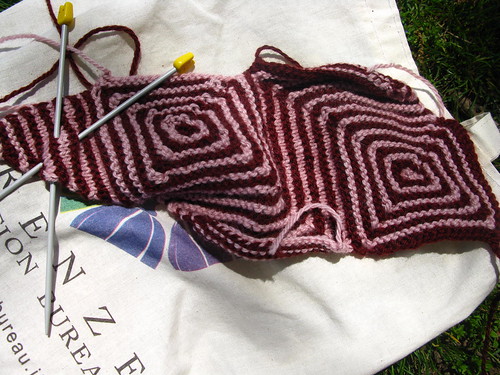
It's going to be a scarf, based on the Step Up afghan from Woolly Thoughts. The pattern is the sort of super-logical and efficient-as-possible one I love. There's lots of picking up stitches, knitting one shape into another, and rules like all triangles are stocking stitch, or vertical parallelograms have garter stitch light-coloured stripes. I'm still getting to grips with these rules, but am getting there.
Rather than what am I knitting, a better question might be where am I knitting it? Ignore the old bag from a conference in Florence; that's a red herring.
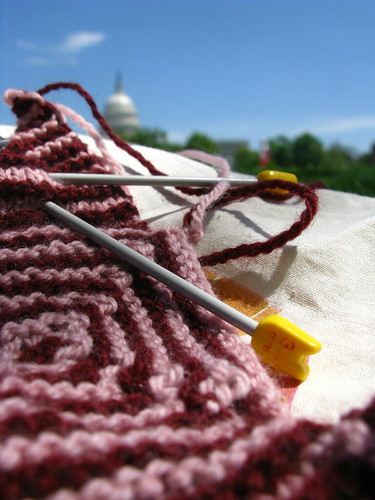
If you can't quite work out that white fuzzy dome in the background, here's a better shot, stepping out from the macro a bit:
I'm in DC for a couple of months, visiting faculty at American University, School of Communication. I'll also be spending a bit of time in New York, Philadelphia, Chicago, Toronto and Ottawa while I’m here. Any don't miss knitting things to do, people to see, yarn to squeeze? (don't think I can make Maryland Sheep and Wool).
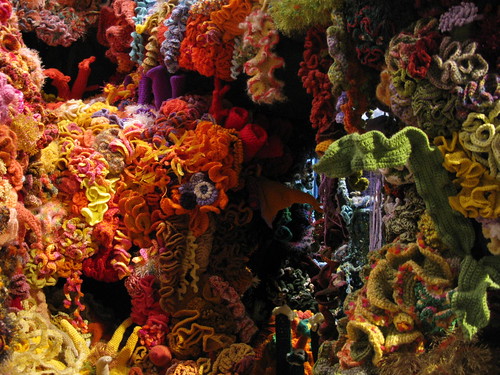
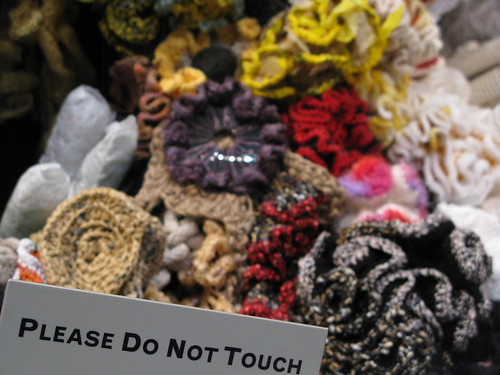
I just managed to catch the last day of the Crochet Reef display at the Smithsonian Museum of Natural History on it's last day. Best two overheards there: "it's not coral, it's made of sweater stuff" (but in a tone of "and OMG that is awesome") and "it wasn't just one person you know, it was loads of people, it's a community project" (again, clearly the speaker thought this was the best bit. I agree).
It's going to be a scarf, based on the Step Up afghan from Woolly Thoughts. The pattern is the sort of super-logical and efficient-as-possible one I love. There's lots of picking up stitches, knitting one shape into another, and rules like all triangles are stocking stitch, or vertical parallelograms have garter stitch light-coloured stripes. I'm still getting to grips with these rules, but am getting there.
Rather than what am I knitting, a better question might be where am I knitting it? Ignore the old bag from a conference in Florence; that's a red herring.
If you can't quite work out that white fuzzy dome in the background, here's a better shot, stepping out from the macro a bit:
I'm in DC for a couple of months, visiting faculty at American University, School of Communication. I'll also be spending a bit of time in New York, Philadelphia, Chicago, Toronto and Ottawa while I’m here. Any don't miss knitting things to do, people to see, yarn to squeeze? (don't think I can make Maryland Sheep and Wool).
I just managed to catch the last day of the Crochet Reef display at the Smithsonian Museum of Natural History on it's last day. Best two overheards there: "it's not coral, it's made of sweater stuff" (but in a tone of "and OMG that is awesome") and "it wasn't just one person you know, it was loads of people, it's a community project" (again, clearly the speaker thought this was the best bit. I agree).
Thursday, March 24, 2011
On the social nature of knitting
Here's a picture of my friend Ed wearing a DNA illusion scarf I've just knitted him. Ed's a prolific and highly respected science writer (he blogs at Not Exactly Rocket Science). He recently included me on a list of top science bloggers, and I joked that if he wanted me to knit him a scarf, he only need ask. I was serious too though. I appreciate the work Ed does, but I get to read it for free. Though he does get paid for much of his writing, he also puts a crazy amount of hours in. Knitting him a scarf was a way of saying thank you.
Illusion knitting is notoriously hard to photograph, so you might have to have a look at the video in this post to really get how the trick really works.
As I've said before, DNA and illusion knitting seemed to be made for one another. The ladders of the striping pattern twist round those of the helix as purls and knit-stitches collect to display a regular shape. I also like that you have know how to look at the scarf to really see the pattern. There's an "OH!" moment when you spot it. Symbolic of the science it reflects, the pattern isn't self-evident.
Presenting Ed with the scarf in the pub last night it was great watching other people respond to it too, and holding it up to the eyes to spot the illusion.
I think this DNA illusion pattern is the knitting project I'm most proud of. It's not so much the product (though I do like the way it looks) or the process of knitting it (though I do enjoy illusion knitting). Rather, it's the social connections that making this scarf has either reflected or helped create.
I'm currently reading a new book about the social dimension of craft - Making is Connecting - so I guess this is on my mind at the moment.
The first one I made was for an ex-geneticist friend, as leaving present for work. I'd only recently learned to knit. Flatmate Kirsty had adapted the alien illusion scarf for her brother, with a picture of Che Guevara. I thought I'd try something similar, and that a design reflecting the iconic double helix would work really well with the illusion pattern.
Then I made another for a scientist/ knitter friend in New York, and wrote up the pattern to share. Then more started popping up. I've had emails from all over the world about the pattern. I've knitted the design into some socks for a science-teacher friend for his birthday, then as a baby blanket for a cousin, and then again as a scarf for a friend when she finished her PhD. I finally made one for myself too. A journalist from UK Wired emailed me and it ended up being mentioned there and it featured on this post on science-knitting. I swear I once spotted someone on the street wearing one (I was on the top deck of the bus at the time so couldn't run up to her and check).
The project is ravelled here if you want to see details of yarn, needles and mods. The pattern is available or through googledocs, or via ravelry.
Illusion knitting is notoriously hard to photograph, so you might have to have a look at the video in this post to really get how the trick really works.
As I've said before, DNA and illusion knitting seemed to be made for one another. The ladders of the striping pattern twist round those of the helix as purls and knit-stitches collect to display a regular shape. I also like that you have know how to look at the scarf to really see the pattern. There's an "OH!" moment when you spot it. Symbolic of the science it reflects, the pattern isn't self-evident.
Presenting Ed with the scarf in the pub last night it was great watching other people respond to it too, and holding it up to the eyes to spot the illusion.
I think this DNA illusion pattern is the knitting project I'm most proud of. It's not so much the product (though I do like the way it looks) or the process of knitting it (though I do enjoy illusion knitting). Rather, it's the social connections that making this scarf has either reflected or helped create.
I'm currently reading a new book about the social dimension of craft - Making is Connecting - so I guess this is on my mind at the moment.
The first one I made was for an ex-geneticist friend, as leaving present for work. I'd only recently learned to knit. Flatmate Kirsty had adapted the alien illusion scarf for her brother, with a picture of Che Guevara. I thought I'd try something similar, and that a design reflecting the iconic double helix would work really well with the illusion pattern.
Then I made another for a scientist/ knitter friend in New York, and wrote up the pattern to share. Then more started popping up. I've had emails from all over the world about the pattern. I've knitted the design into some socks for a science-teacher friend for his birthday, then as a baby blanket for a cousin, and then again as a scarf for a friend when she finished her PhD. I finally made one for myself too. A journalist from UK Wired emailed me and it ended up being mentioned there and it featured on this post on science-knitting. I swear I once spotted someone on the street wearing one (I was on the top deck of the bus at the time so couldn't run up to her and check).
The project is ravelled here if you want to see details of yarn, needles and mods. The pattern is available or through googledocs, or via ravelry.
Monday, January 24, 2011
A "strawman" scarf
I don't know if you have ever heard the term "straw-man argument"? Loosely, it means arguments that are aimed at a problem that doesn't really exist. It's a classic debating technique. You make up an extreme version or caricature of your opponent's argument (the "straw-man") which is all the easier to knock apart.
So, the expression "but you're straw-manning me!" is a fair and useful term in some contexts (I have used it myself). It helps you point out and defend yourself against unfair criticism, and it helps you pass the rhetorical trick right back at your opponent as, by taking aim at the premise of their argument, it can be reasonably hard to think of a come back.
But the term can be overused. Sometimes what looks like a deliberately rhetorically constructed straw-man is simply a misunderstanding. It's accidental. In fact, it might even be the fault of the person claiming they've been straw-manned. If someone doesn't understand your position, maybe you didn't made yourself very clear in the first place?
Closing an argument with a call of "straw-man!" for a bit of oneupmanship in a debating chamber be all part of the fun, but if the aim is mutual understanding, I'm not convinced it's productive. I'd much prefer people took an interest in why they have been misunderstood/ are being misinterpreted. A lack of understanding can be a chance for everyone to learn: a chance to continue debate, not end it.
Having seen the term once too many one evening, I decided to exorcise my grumpiness the best way I know how: knitting.
I thought about knitting a small straw-coloured toy, like the voodoo doll I made in a moment of whimsical annoyance at the structures academic admin a few years back.
But a doll's pretty useless - as much of my annoyance with the term phrase was that it's not productive, it seemed a bit silly. So, instead, I made a small straw-coloured scarf with a man symbol embroidered at one end. The stitch pattern is from My So Called Scarf, which I thought brought out a straw-y texture (see ravelry project page for full details about yarn, etc).
I've now posted it to a friend who was at the receiving end of some particularly unhelpful "you're just straw-manning me" bit of rhetoric last year. Because debate should be about sharing with others, not keeping the prizes for yourself.
Sunday, January 09, 2011
Time catching up
2011 is the year I turn 30. This isn't something I'm especially worried about. You can't work in a university (as I do), surrounded by all the hope and energy of youth, and have a problem with feeling older. If anything, I quite like the idea of growing towards wise old biddie status.
Still, I admit that on opening a new calendar on the 1st of Janurary and realising this really was the year I'd leave my 20s, I painted my fingernails with purple glitter and dug out some very old CDs.
Luckily, I have a host of friends who have recently passed through the big 3-0 to guide me on my way. I've already blogged about flatmate-Kirsty turning 30. Here are two scarves I made over the Christmas break for other recently-turned-30 friends.
First up, a scarf for my old university friend, Uslan. You'll have to excuse the slightly dodgy iphone pics - I left my camera at home on the only afternoon I had the scarves before I wrapped them up to give them away.
I've made a scarf for Uslan before (Exchequered, which is in Spring '06 Knitty) but that was about five years ago, so I offered a new one. We discussed size, shape and colour and after passing some example photos back and forth, this is the result: four skeins Colinette Point 5 knitted in brioche rib on giant 10mm needles (see ravelry project page). As Kirsty said about the yarn: it's as if Barbie was sick on a sheep.
The resulting scarf is also incredible long. A scarf to wrap yourself in and hide (or possibly just mask your wrinkles, not that Uslan has wrinkles, I'm sure).
Secondly, a small shawlette for Anne-Marie, who I was at university with and worked at the Science Museum with too. Anne-Marie was also my old flatmate before I lived with Kirsty: we had a teeny-tiny little flat by Mornington Crescent (amazing views over Euston Station).
The pattern is Haruni by Emily Ross. This is meant to be entirely lace, but I subbed chart A for a bit of plain knitting, because that’s what the cool kids do. However, rather than the stocking stitch most people seem to opt for, I went for garter stitch. I'm on a bit of a garter stitch kick at the moment. I used felted tweed, which is supposed to be a DK weight, but is nearer 4ply so it's quite small, but a pretty little shawlette nonetheless (ravelry project page).
Still, I admit that on opening a new calendar on the 1st of Janurary and realising this really was the year I'd leave my 20s, I painted my fingernails with purple glitter and dug out some very old CDs.
Luckily, I have a host of friends who have recently passed through the big 3-0 to guide me on my way. I've already blogged about flatmate-Kirsty turning 30. Here are two scarves I made over the Christmas break for other recently-turned-30 friends.
First up, a scarf for my old university friend, Uslan. You'll have to excuse the slightly dodgy iphone pics - I left my camera at home on the only afternoon I had the scarves before I wrapped them up to give them away.
I've made a scarf for Uslan before (Exchequered, which is in Spring '06 Knitty) but that was about five years ago, so I offered a new one. We discussed size, shape and colour and after passing some example photos back and forth, this is the result: four skeins Colinette Point 5 knitted in brioche rib on giant 10mm needles (see ravelry project page). As Kirsty said about the yarn: it's as if Barbie was sick on a sheep.
The resulting scarf is also incredible long. A scarf to wrap yourself in and hide (or possibly just mask your wrinkles, not that Uslan has wrinkles, I'm sure).
Secondly, a small shawlette for Anne-Marie, who I was at university with and worked at the Science Museum with too. Anne-Marie was also my old flatmate before I lived with Kirsty: we had a teeny-tiny little flat by Mornington Crescent (amazing views over Euston Station).
The pattern is Haruni by Emily Ross. This is meant to be entirely lace, but I subbed chart A for a bit of plain knitting, because that’s what the cool kids do. However, rather than the stocking stitch most people seem to opt for, I went for garter stitch. I'm on a bit of a garter stitch kick at the moment. I used felted tweed, which is supposed to be a DK weight, but is nearer 4ply so it's quite small, but a pretty little shawlette nonetheless (ravelry project page).
Monday, January 03, 2011
FO: Woodland Capelet
A small shawl, knitted for flatmate-Kirsty as a Christmas present.
Kirsty always complains about her shoulders being cold, and wraps big scarves around herself as she sits at her desk to work. I thought this would help keep her shoulders warm, but also be elegant enough to wear out with a dress too. I wondered about bringing out some of the golds in the yarn with a bit of embellishment to glam it up a bit, but decided it was better to keep it plain. Kirsty can always add a broach.
The pattern is Woodland Capelet by Susan Mills. It was a fun knit. Unchallenging, but as I blogged yesterday, I've been so busy the last year, I couldn't really cope with anything difficult. It's all simple garter stitch, but the changes of the shoulder shaping and zigzaggy edge to stop you from getting bored.
I'm on a bit of a garter stitch kick at the moment, it as a sort of homespun sophistication (if we can even have "homespun sophistication". I think we can).
The yarn is a mix of recycled silk, cotton and rayon, which makes for a rather warm combination, despite not being obviously woolly.
Full details on the ravelry project page.
I also made a pair of green socks for Kirsty's partner, Anthony. Simple toe-up in basketweave stitch (see that project's ravelry page). I made him almost the exact same pair last year, but brown. As Kirsty says: Anthony likes brown, green and things he has already.
Sunday, January 02, 2011
New Year, New Hat

So, I walked into a tree.
In my defense, it wasn't the trunk of the tree I walked into, just a bit of a branch. Also, it was snowing quite hard, and I had my eyes on the ground, checking for ice so I didn't slip.
It was on Clapham Common a bit before Christmas, and the point of this story is that I was so dazed from the cold branch hitting me in the face, not to mention checking my glasses weren't scratched, that I didn't realise my hat had fallen off. When I went back to look, it had gone.
I needed a new hat. I picked up a ball of kid classic and a 3.5mm circular needle. I cast on 4 stitches and started working in the round. I increased four stitches every other round until it was roughly wide enough, then worked a 4x4 rib until I'd nearly run out of yarn, and cast off.
Result: one pixie-point red hat, perfect for the Christmas holidays. Final finished piece of knitting for 2010. Ravelry project page.
Conclusion: New Year's Resolution number one is to stop walking into trees.
My New Year's Resolution number two is the more serious one: do less. I've been rushed off my feet all year. I've had so much work, I haven't left much time for many of my friends, time for myself, or even simple things like tidying my room, exercise, cooking properly or sleep. I've hardly had time for a weekend, let alone a holiday. I've gone from being one of the most organised people I know, to turning up late to meetings. I've also been late with a couple of projects, and rushed a few more. I hate that. "If it's worth doing, it's worth doing properly", and all that.
2010 was a lot of fun. I've made new friends and achieved things I've never thought possible, but I finished it absolutely exhausted. Next year: do less, but do it better and be happier. That said, looking at my diary for 2011 I have some really exciting things planned. I'm going to be writing and speaking about some amazing things, and visiting some fantastic places. I just need to keep it all under control.
Having finally taken some time off over the holiday season, I've taken time to knit a few Christmas presents and pieces for friends who have recently turned 30 (urgh, 2011 is the year I do too). Will post them all soon.
... and yes, my eyes are different colours.
Tuesday, September 21, 2010
Knitted Higgs
Last week, I knitted a Higgs Boson. I am more than aware that this is even more ridiculous than the "Rosalind" DNA illusion scarf. As least that scarf was (a) inspired by some ideas in the history and sociology of genetics (b) keeps my neck warm and toasty now the nights are drawing in. This is just blue lump (roughly 10cm wide) inspired by little more than a challenge on twitter and embroidery based on a google image search for "higgs boson". And anyway, it's really more a representation of the particle collisions working at the LHC in the search for the Higgs than the boson itself. And um... a very sketchy representation at that.
The reason for actually taking the time to bother to produce the thing was to provide a jokey prize for a competition run to encourage people to pre-order a Geek Calendar. The Geek Calendar project is, arguably, yet another ridiculous idea. Dreamed up in a pub one night, we joked that we could easily sell a calendar of nerds in aid of libel reform (quite a cause in several geeky corners of the UK). We laughed about it on twitter and got a huge response (it trended in London), thought why not and... um... a few months (and 15 photoshoots) later, we've sold several 100 on pre-orders alone already. You can see a tiny preview, but it's not even printed yet.
If I'm honest, I was already slightly sick of the self-conscious re-claiming of the word "geek" even before I started this project (positively retching at it now...). Still, I do think it's worth celebrating the various nerdish elements of contemporary life. People do specialist things. In detail. They get inspired and obsess. And they're cool. This has always been true, but I think it's more obvious today. We rely on detailed specialist knowledge more and more, and the internet has let us connect specialist interests more easily. Whether this is dedication to a cause, an over-achiever hobby or simply sharing a love of antique calculators, there's a lot of this geeking about. We rely on detailed specialist knowledge more and more, and the internet has let us connect specialist interests more easily. Crucially, this sense of specialism means there is no single definition of what a geek likes or does, there are multiple ways to get your geek on, as we all run down our own various rabbit holes. In many ways, knitting is a perfect example of this, the very niche area of science knitting, even more so.
Check out our flickr to see how much fun I've had at the photoshoots. You can pre-order a calendar now, or proper printed ones will be available from the end of October. If you want to read more about the problems of libel law in the UK, I can recommend this recent essay by Alan Rusbridger.
See also the ravelry project page for info, not that there is much more information there. Really: a blue ball, embroidered, stuffed and closed. That's it. The actual hunt for the Higgs is way more interesting.
The reason for actually taking the time to bother to produce the thing was to provide a jokey prize for a competition run to encourage people to pre-order a Geek Calendar. The Geek Calendar project is, arguably, yet another ridiculous idea. Dreamed up in a pub one night, we joked that we could easily sell a calendar of nerds in aid of libel reform (quite a cause in several geeky corners of the UK). We laughed about it on twitter and got a huge response (it trended in London), thought why not and... um... a few months (and 15 photoshoots) later, we've sold several 100 on pre-orders alone already. You can see a tiny preview, but it's not even printed yet.
If I'm honest, I was already slightly sick of the self-conscious re-claiming of the word "geek" even before I started this project (positively retching at it now...). Still, I do think it's worth celebrating the various nerdish elements of contemporary life. People do specialist things. In detail. They get inspired and obsess. And they're cool. This has always been true, but I think it's more obvious today. We rely on detailed specialist knowledge more and more, and the internet has let us connect specialist interests more easily. Whether this is dedication to a cause, an over-achiever hobby or simply sharing a love of antique calculators, there's a lot of this geeking about. We rely on detailed specialist knowledge more and more, and the internet has let us connect specialist interests more easily. Crucially, this sense of specialism means there is no single definition of what a geek likes or does, there are multiple ways to get your geek on, as we all run down our own various rabbit holes. In many ways, knitting is a perfect example of this, the very niche area of science knitting, even more so.
Check out our flickr to see how much fun I've had at the photoshoots. You can pre-order a calendar now, or proper printed ones will be available from the end of October. If you want to read more about the problems of libel law in the UK, I can recommend this recent essay by Alan Rusbridger.
See also the ravelry project page for info, not that there is much more information there. Really: a blue ball, embroidered, stuffed and closed. That's it. The actual hunt for the Higgs is way more interesting.
Sunday, September 12, 2010
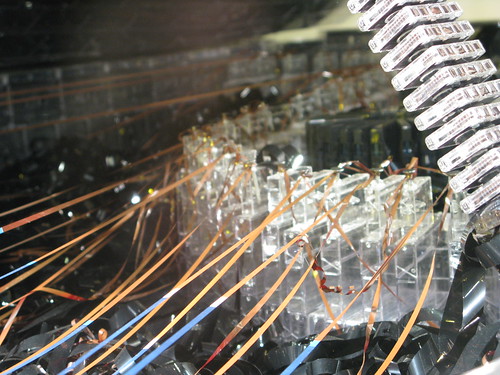
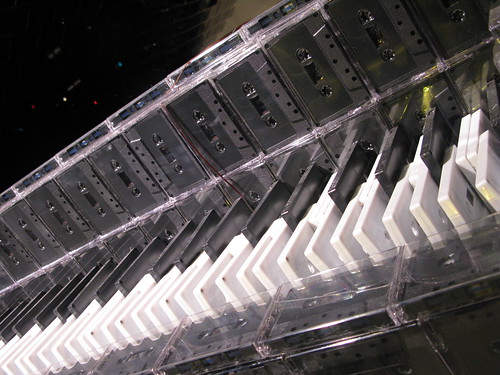
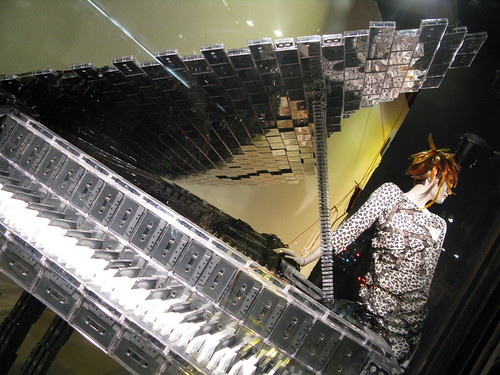
Piano made from cassette tapes
This has nothing to do with knitting but it's something somebody made and I think it's beautiful. A "piano" built from cassette tapes. It's from a Harvey Nicholls window display, hence the mannequin in the background of the last image.
I love the way they've used black and white tape cases to make the keys, as well as empty cases and a mix of standard sized and smaller DAT tapes. I think my favourite bit is the use of the tape itself - again of varying sizes, as strings of the piano.
I took the photos on the way home from the Natural History Museum last month, after helping out at their Stitch a Squid workshop. It was around 10pm - late-opening at the Museums - and the light shining through the transparent tape cases sparkled in the dark.
If you want another (tenuous) knitting reference, here's a picture of some piano socks I made a few years back.
Normal knit-blogging will resume shortly. I'm currently knitting a higgs boson. Why? Look here.
I love the way they've used black and white tape cases to make the keys, as well as empty cases and a mix of standard sized and smaller DAT tapes. I think my favourite bit is the use of the tape itself - again of varying sizes, as strings of the piano.
I took the photos on the way home from the Natural History Museum last month, after helping out at their Stitch a Squid workshop. It was around 10pm - late-opening at the Museums - and the light shining through the transparent tape cases sparkled in the dark.
If you want another (tenuous) knitting reference, here's a picture of some piano socks I made a few years back.
Normal knit-blogging will resume shortly. I'm currently knitting a higgs boson. Why? Look here.
Thursday, August 19, 2010
Busy bees
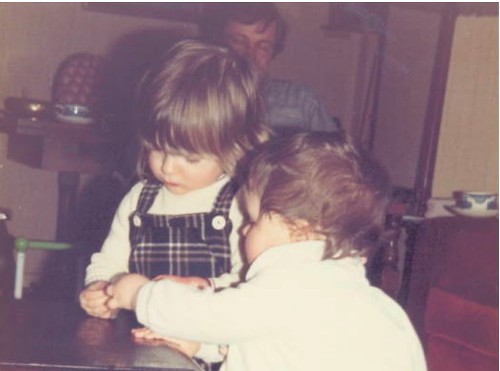
A baby photo of me and my flatmate Kirsty. Yes, Kirsty who made the awesome Wonder Woman jumper that got Boing-ed. That Kirsty.
Our parents have known each other since they were teenagers, and I've known Kirsty since before I could speak. We've shared a flat together for six years now. We joke that when we do finally stop living together we'll never manage to disentangle our joint knitting needle collection. In truth, it'll be a lot more than just that.
She is a bit under a year older than me. Which means she's got to do most things first. She learnt to speak, learnt to walk and learnt to knit first. She went to university first, she left university first (something I'm still struggling to do). She was even Alice before me, as it's her middle name. And she turned 30 first too, yesterday to be precise. See her failing to blow out all the candles in one go.
On such a momentous occasion, I could bang on about what an amazing person Kirsty is, how much she has taught me, how much she means to me. But it's not really my style. Or hers. Or our relationship's. Or this blog's. Instead, I'll show you one of the birthday present I knitted for her and take some photos of her feet.
Legwarmers, covered in bees. One hundred and eighty bees to be precise. Nine sets of bees, each containing ten bees.
They are based on Pinneguri's bumblebee socks, but legwarmer-ised (larger circumference, and no toe or heel). I also striped brown and yellow yarn, rather than use self-striping, and stuck to just the three colours. I think the amazing yellow yarn really makes them, it's Jitterbug in "Vincent's Apron".
The project is ravelled here which includes full details of yarn and needles and link to pattern.
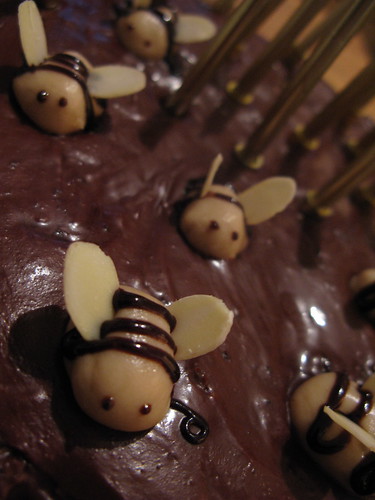
It was part of a bee-themed collection of presents (largely inspired by the legwarmers, Kirsty has no special "thing" about bees, though obviously we all know bees are cool). This included sponsorship of a beehive, honey bath things, an actual pot of honey, and a bee-covered honey and chocolate cake.


Our parents have known each other since they were teenagers, and I've known Kirsty since before I could speak. We've shared a flat together for six years now. We joke that when we do finally stop living together we'll never manage to disentangle our joint knitting needle collection. In truth, it'll be a lot more than just that.
She is a bit under a year older than me. Which means she's got to do most things first. She learnt to speak, learnt to walk and learnt to knit first. She went to university first, she left university first (something I'm still struggling to do). She was even Alice before me, as it's her middle name. And she turned 30 first too, yesterday to be precise. See her failing to blow out all the candles in one go.
On such a momentous occasion, I could bang on about what an amazing person Kirsty is, how much she has taught me, how much she means to me. But it's not really my style. Or hers. Or our relationship's. Or this blog's. Instead, I'll show you one of the birthday present I knitted for her and take some photos of her feet.
Legwarmers, covered in bees. One hundred and eighty bees to be precise. Nine sets of bees, each containing ten bees.
They are based on Pinneguri's bumblebee socks, but legwarmer-ised (larger circumference, and no toe or heel). I also striped brown and yellow yarn, rather than use self-striping, and stuck to just the three colours. I think the amazing yellow yarn really makes them, it's Jitterbug in "Vincent's Apron".
The project is ravelled here which includes full details of yarn and needles and link to pattern.
It was part of a bee-themed collection of presents (largely inspired by the legwarmers, Kirsty has no special "thing" about bees, though obviously we all know bees are cool). This included sponsorship of a beehive, honey bath things, an actual pot of honey, and a bee-covered honey and chocolate cake.


Labels:
baking,
browns,
chocolate,
colourwork,
extra-knitular,
FOs,
legwarmers,
yellow
Thursday, July 29, 2010
Breezy Brighton
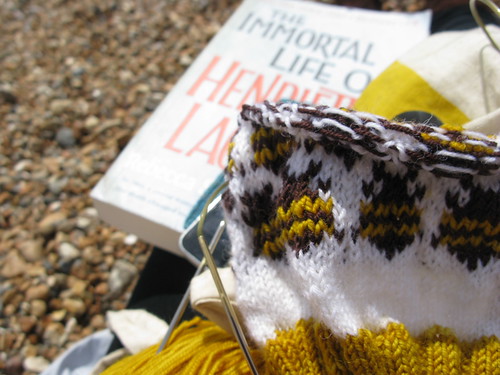
Here I am on Brighton beach, with my newly knitted socks. Full knitterly details like yarn, etc on ravelry, this post'll explain why I knitted them.
The bobbles running up each side are organised to represent the word "yakawow" in braille. Back in mid-April, the Times published an interview with controversial scientist, Baroness Greenfield. She'd said all a whole host or objectionable and/ or funny things in this interview, and people were chipping in with their favourite bits. "Crowd reading", if you will. Someone quipped "She's right abt 1 thing: we don't want "load of breezy people who go around saying yaka-wow". Cos that would be MENTAL". Another replied with "Yaka-wow must used more! Dunno its meaning but ace phrase".
They were clearly onto something. I logged into twitter a few hours later, after a very serious evening discussing the role of science communication in the developing world, to discover a @yakawow account was now following me. (I still don't know who is behind this account, though I have my suspicions). There were also tshirts for sale, a youtube video, various photoshopped images and facebook page.
It turned out Greenfield didn't coin a new term. It was a transcription error of "yuck and wow", a phrase Greenfield has often used to describe the way people act online, running quickly from one sensation to another. Greenfield is (in)famous for her concerns that computer games and social networking sites are damaging our brains, leading to short attention spans and an inability to empathise (e.g. see this news piece). This makes more sense than "yakawow", but Greenfield's views on computers is not without its critics (short version: all very well as an idea, but it lacks evidence).
The yakawow meme kept running. It was Boing-ed. Quick to celebrate the new word they had invented, the The Times wrote about it (see also this cartoon, from print version). The New York Times vocab blog picked it up and apparently it's in the latest edition of Wired, though I haven't see a copy yet.
One of my old students challenged me to knit yakawow. It had to be socks. Greenfield famously referred to twitter as "reminiscent of a small child saying "Look at me, look at me mummy! Now I've put my sock on. Now I've got my other sock on". I also thought the word would provide an opportunity to play with knitting braille, something I'd been thinking about trying for ages.
I worked three panels of the word, loosely reflecting the streams of code in the poster for the Matrix (a play on Greenfield's suggestion that computer mediated communication is somehow not real). I knitted them one at a time, rather than two-at-once-on-a-huge-circular to mirror Greenfield's point about people on twitter saying they'd put on one sock and then another. They were also from the bottom up: read something into that if you want, I can't be bothered to extend the symbolism any further.
When I wear these socks, I will wiggle my toes inside them and celebrate my belief that interacting online is not without its tangible consequences. Social media sites, not least knit blogging and ravelry, provide real relationships with real people doing real things. Imaginative and clever people who get together to collaboratively discover, develop, teach, learn, critique and create. As the Times' piece on yakawow concludes:
Baroness Greenfield, take note. These people’s brains haven’t atrophied yet. They have taken your interview and created a whole new universe. I think, therefore I yaka-wow.Still, it can be nice to have a break from it all. Which is why although this photo was taken on Brighton beach on Monday, I didn't blog about it until today. I've been away from the internet, reading a book and knitting a legwarmer. I also took those socks off and went for a bit of a paddle.
Sunday, May 16, 2010
FO: leaves scarf
Leaf scarf done. Or at least I call it a scarf, I think I’m might use it as bunting, it’s not the sort of thing I’d wear normally. It's a bit big for a necklace and too small for a scarf. That said, I don't really have much call for bunting either. It's finished anyway, even if I'm not sure what I'll do with it yet.
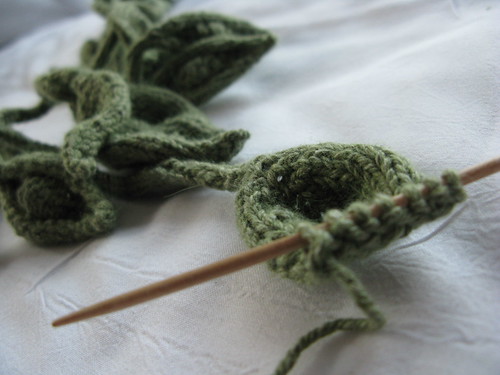
It was always more of a process knit rather than something produced for the final product. A nice easy project to take to knitting groups. I had a few balls of green yarn leftover from a sweater. I didn't want a green hat or a green scarf. I liked how grassy the yarn was. So I decided to knit some leaves.
It's really just icord with the odd leaf growing out of it. I kept knitting until I run out of yarn, adding new stems and leaves wherever looked appropriate. The leaves were easy to make, 2kfb, k, turn, sl1, k2. Then continue to increase either side of the center stitch every RS row until it was big enough, then a few plain rows, before decreasing back again (always slipping the first stitch of each row). I did a center decrease where you slip 2 sts at once, k1, then pass both slipped sts over at once. This helps make the "stem" of the leaf pop. Yes, there were a lot of ends to sew in, but I just did them as I was going rather than leaving them to the end of the project.
The result was a long vine of quite crumbled leaves. Most people I showed the WIP seemed to like this look. I did too, but I also really wanted to see what would happen if I blocked it, how (or if) I could re-shape the leaves. Above is a pre-blocking shot, below shows after. This "during" shot shows the leaves flattened out for a bit, but it didn't make much difference in the long run.
The above shot is also a "bunting" shot as opposed to one of me wearing it as a scarf, below. What do you think, bunting or scarf? (or something else?). All ideas gratefully crowd-sourced.
As ever, there are a few notes on the yarn and needles on the project's ravelry page (n.b. this is public ravelry link, you don't have to be logged it to see it. Ravelry project pages don't have to be exclusive any more, how cool is that?).
Sunday, April 04, 2010
Easter Nests
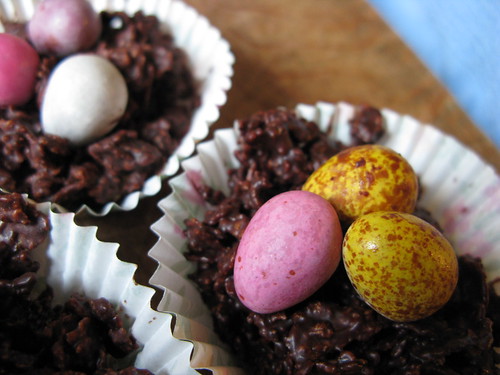
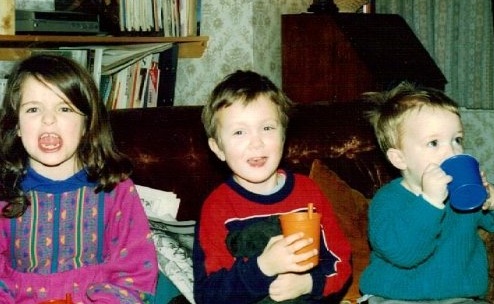
My cousin Iain tweeted that he'd made some "Easter nests" the other night. Cue: wave of nostalgia for childhood Easter holidays covered in chocolate. For some reason I always associate these little piles of chocolate-coated breakfast cereal decorated with Mini-Eggs with my Aunt Susie (Iain's mum) so I guess she always made them. Our families would often see each other at some point around the Spring holidays. I'm the one with the long hair trying to be a scary lion.
I'd planned to bake brownies for my mum and little brother instead of giving them a chocolate egg each but, after reading Iain's tweet, decided Easter Nests were in order. You should use mashed up Shredded Wheat for nests because it looks the most stick-like. Nestle products aren't allowed in our flat, so I ended up using Co-op Bran Flakes instead. Much more fiber, plus fortified with iron (people who like magnets: follow that link). I also used plain rather than milk chocolate, which I melted with some golden syrup to sweeten and give a slight chew to the texture. The result are rather grown up Easter Nests, best eaten slowly over a cup of tea. Flatmate-Kirsty had a glass of milk with hers. They are strong and earthy, but very good.
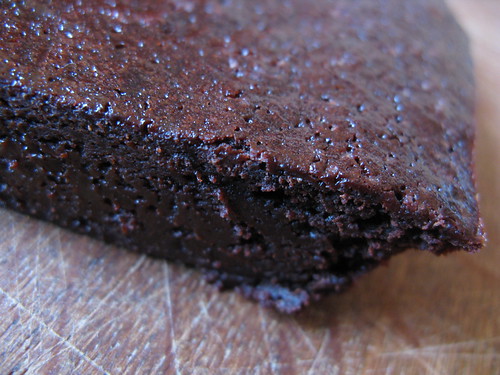
I made a round of brownies for mum and Jim too. He'd only complain otherwise (apparently baking brownies is what big sisters are for, even when you're both speedily approaching 30).
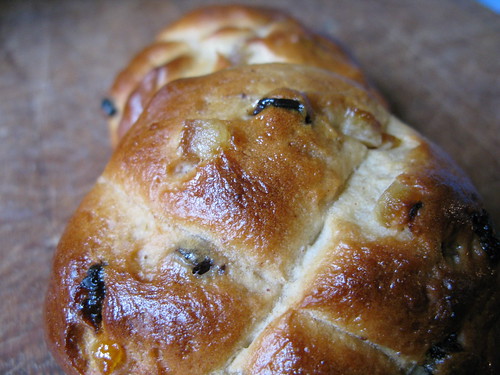
I used this awesome recipe. They are also exceedingly chocolaty and best eaten in small quantities with a cup of tea, especially as I decreased the sugar quantity slightly to bring out the chocolate. Still, I dare say Mum and Jim will get through them. Kirsty beat me with the whole Easter baking though, because she fought with some slightly old yeast to make annoyingly perfect hot cross buns (everything Kirsty makes is annoyingly perfect).
Normal knit blogging will resume in a week or so. I've got an arm and a half to do on my top-down Demi and only about another half ball more to knit of the leaves scarf, so I hope I'll have an FO to show. You can also find more work related blogging from me here (including piece about a 1958 Girls-own chemistry set which featured a pink microscope).
Subscribe to:
Posts (Atom)